You own a car but can’t register it because the original title is missing. This means you can’t legally drive it.
You have options.
This guide covers three legal ways to register a car without a title in Texas. Each section gives you the exact steps and documents needed.
TL;DR
Here are the key facts you need to know about registering a car without a title in Texas.
- Try the seller or title replacement first. If the seller can help or you are the recorded owner, those paths cost less. A bonded title works when those options fail.
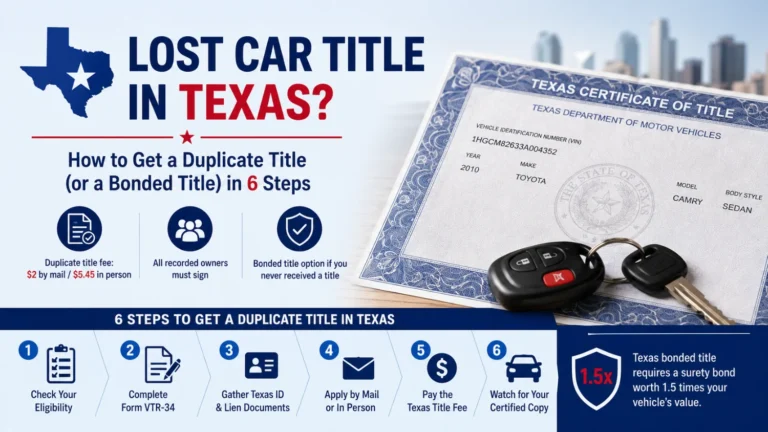
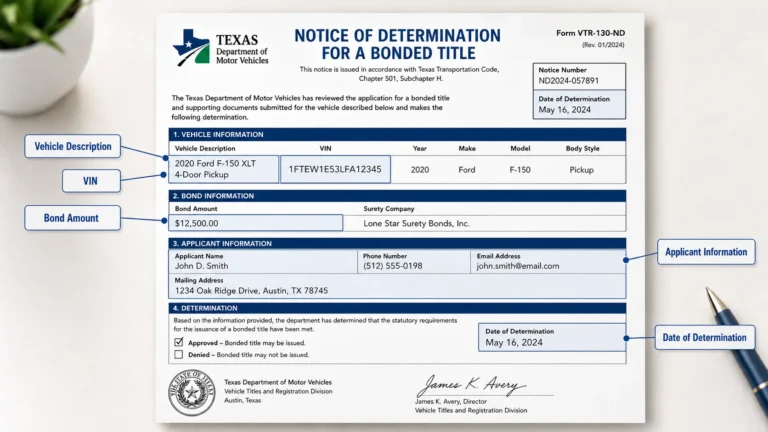
- TxDMV reviews your case and sets a bond amount. They issue a Notice of Determination letter. The bond amount equals 1.5 times your vehicle value.
- You buy a title bond from a surety company. The actual cost you pay starts at $100. This is much less than the bond amount.
- File at your county tax office within 30 days. This deadline matters. You submit the bond and complete your registration.
- Safety inspections ended January 1, 2025. Most non-commercial vehicles no longer need them. Emissions testing still applies in 17 Texas counties.
Can You Register a Car Without a Title in Texas?
No. You cannot register a car in Texas without a valid vehicle title or legal substitute. The state requires proof of ownership before processing any registration.
The term “no title” covers several situations. You might have lost the original vehicle title. The seller may have never titled the car in their name. The title might be signed incorrectly or missing required signatures. A lien might show on record even though the loan is paid off.
Texas provides legal ways to get a title when the original is missing. The bonded title is the most common option for buyers who purchased a vehicle without proper paperwork. Other paths work better when the previous owner can help or when you inherited the vehicle.
Once you have the title through one of these paths, you can complete your registration. The next section helps you choose the right path for your case.
Choose the Right Path for Your Situation
Your next step depends on who owned the vehicle before you. Here are the three main paths to get a title in Texas.
Path 1: Get a Duplicate Title from the Previous Owner (Fastest Route)
This option works when the seller is cooperative and is still the recorded owner. The previous owner requests a certified copy using Form VTR-34. The cost is $2 to $5.45.
Path 2: Apply for a Bonded Title
This option works when you buy a car without proper paperwork, and the seller cannot help. You prove ownership to TxDMV, purchase a surety bond, and file for your title. The total cost is $250 to $800. This guide covers bonded titles in detail below.
Path 3: File an Affidavit of Heirship for Inherited Vehicles
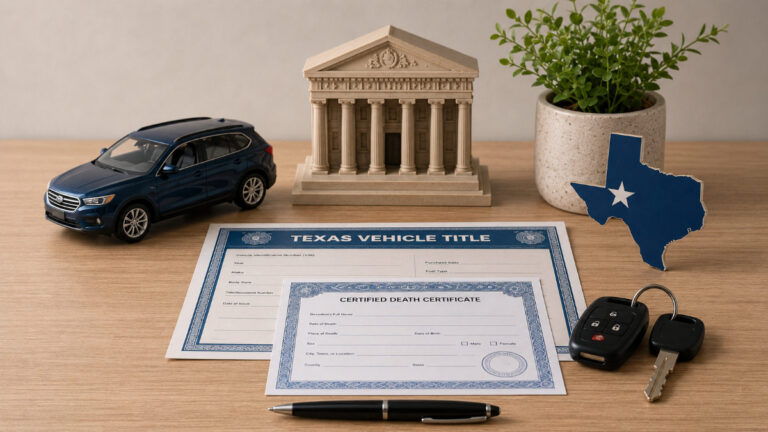
This option works when you inherit a vehicle from a deceased family member. You complete Form VTR-262 and pay standard title transfer fees. Standard title fees apply.
Documents That Prove Vehicle Ownership in Texas
TxDMV requires proof of ownership before approving a bonded title. The stronger your documentation, the faster your application gets approved.
Here are the most common proof documents Texas accepts:
- Bill of sale with buyer name, seller name, VIN, odometer reading, date, and price
- Receipt or invoice showing you paid for the vehicle
- Canceled check or bank statement proving payment
- Prior registration in your name or the seller’s name
- Improperly assigned title, even if incomplete or unsigned
- Lien release or letter of no interest if a loan shows on record
- Transfer paperwork from the seller
You do not need every document on this list. Submit everything you have. More documents make your case stronger.
Three ways to strengthen your file:
- Make sure the VIN matches on every document. One wrong number causes delays.
- Include complete seller information. Add their name, address, and phone number on the bill of sale.
- Date and sign all documents. TxDMV needs to verify when the transfer happened.
Texas Bonded Title: Steps, Costs, and Requirements
How to Register a Car in Texas Without a Title
The registration process depends on your situation. Follow the path that matches your situation from start to finish.
Path 1: Register with a Title from the Seller (Fastest Route)
This path works when the seller is available and cooperative.
Step 1: Contact the Seller for the Title
Ask the seller to apply for a certified copy if the original title is lost. They complete Form VTR-34 at their county tax office or TxDMV Regional Service Center. Most sellers cooperate when they understand you cannot register without it.
Step 2: Receive and Verify the Signed Title
Check that the VIN matches your vehicle exactly. Verify all signatures are present and correct. Make sure the title is properly assigned to you with no errors or blank spaces.
Step 3: Complete Emissions Test (If Required)
Safety inspections ended for most non-commercial vehicles. Emissions tests still apply in 17 Texas counties. Check if your county requires emissions testing before you file.
Step 4: File at Your County Tax Office
Submit the signed title and Form 130-U. Bring proof of insurance and your photo ID. This step starts your registration application.
Step 5: Pay Fees and Get Your Plates
Pay the registration fee, title fee, and inspection program replacement fee. Bring cash, check, or money order for payment. You will receive your registration receipt, license plates, and sticker the same day at most county offices.
Path 2: Register with a Replacement Title
This path works when you are already the legal owner on record but lost or never received the physical title.
Step 1: Confirm Your Eligibility
TxDMV records must show you as the owner. Contact your county tax office to verify your name appears on file. You can also check online if your county offers title record searches.
Step 2: Apply for a Certified Copy
Complete Form VTR-34 and submit it to your county tax office. Include a copy of your photo ID and a $2 fee for mail processing. In-person applications at a TxDMV Regional Service Center cost $5.45. Pay by check or money order made payable to TxDMV
Step 3: Receive Your Replacement Title
Mail applications take 10 to 15 business days. In-person visits often provide same-day processing. You will receive a certified copy that works exactly like the original title.
Step 4: Complete Registration
Complete an emissions test if your county requires it. Then file at your county tax office with your replacement title, Form 130-U, proof of insurance, and photo ID. Pay registration and title fees to receive your plates and sticker.
Path 3: Register with a Bonded Title
Use this path when the seller is unavailable or when no prior title exists in the TxDMV system. It also works when the title chain has gaps or missing documentation.
You must prove ownership to the TxDMV, buy a surety bond, and file with your county tax office. Total cost ranges from $250 to $800 based on vehicle value.
See the section below for complete steps, required documents, and filing deadlines.
How to Get a Bonded Title in Texas
This section explains how to get your vehicle registered with a bonded title. Follow these steps when you need to establish legal ownership when the title is lost.
Step 1: Check VIN and Clear Any Liens
Verify the VIN on your vehicle matches all paperwork exactly. Mismatched numbers block approval and waste your application fee.
Check for liens next. Active liens under 10 years old prevent bonded title approval. Contact the lienholder to get a lien release or a letter of no interest. Wait until you have this document before applying.
Liens older than 10 years do not block your application. TxDMV considers these liens expired for bonded title purposes.
Step 2: Gather Your Proof of Ownership Documents
Collect all documents listed in the Documents That Prove Vehicle Ownership section above. The strongest proof includes the bill of sale, receipts, canceled checks, prior registration, and transfer paperwork.
Submit everything you have. TxDMV weighs the total evidence when reviewing your case. Three weak documents together often work better than one strong document alone.
Step 3: Complete the Statement of Fact (Form VTR-130-SOF)
Complete Form VTR-130-SOF in full. This form asks how you got the vehicle and why no title is available. Answer every question. Blank fields cause automatic rejection.
Write a clear explanation in the narrative section. Describe when you bought the vehicle, who sold it to you, and what happened to the title. TxDMV uses this statement as the primary evaluation document.
Step 4: Submit Your Packet to the TxDMV Regional Office
Submit your completed Form VTR-130-SOF, proof documents, photo ID, and $15 fee to a TxDMV Regional Service Center. Texas has 16 locations statewide. You can apply in person or by mail.
TxDMV reviews your case to determine if you qualify and to calculate the bond amount. Processing time ranges from 1 to 3 weeks, depending on case complexity and office workload.
Step 5: Receive Your Bond Amount Letter
TxDMV sends you a Notice of Determination when they approve your application. This letter states your required bond amount. TxDMV determines vehicle value using the Standard Presumptive Value calculator or NADA guide.
You must have this letter to purchase your Texas title bond. You have one year from the date of the letter to buy the bond and file your application.
Step 6: Purchase Your Texas Title Bond
Buy a surety bond from a licensed provider for the amount stated on your Notice of Determination. The bond protects prior owners or lienholders if someone challenges your ownership during the three-year bonded period.
The bond amount equals 1.5 times the value of the vehicle. Your actual cost is much smaller. Most Texas title bonds cost $100 to $400 based on your vehicle value.
TMD Surety Bonds offers instant quotes and same-day bond delivery online. Get Your Title Bond Now.
Step 7: File Your Application at the County Tax Office
Submit your title application and bond to your county tax assessor-collector’s office. You must file within 30 days of the bond’s effective date. Missing this deadline voids your bond and requires you to purchase a new one.
Bring these documents to your appointment:
- Original surety bond (Form VTR-130-SB)
- Form VTR-130-SOF (both pages)
- Notice of Determination from TxDMV
- All proof of ownership documents
- Valid photo ID
- Proof of insurance
Some counties require appointments for bonded title transactions. Call ahead to confirm their process and avoid wasted trips.
Step 8: Receive Your Bonded Title
The county issues your new title with “BONDED” printed on it. This notation shows a surety bond backs the title. You can now register your vehicle legally and get license plates.
The bond remains in effect for three years from the effective date. During this period, prior owners or lienholders can file claims if they believe they have ownership rights. Claims are rare.
You can remove the bonded notation after three years with no claims. Apply to TxDMV for a standard title. Check TxDMV guidance for the current process.
Texas Bonded Title Cost and Bond Amount
The bond amount and your actual cost are different numbers. The amount of the bond equals 1.5 times your vehicle value. Your actual cost is the premium, which starts at $100.
Bond amount vs premium: TxDMV sets the bond amount based on your vehicle value. This protects prior owners if claims arise. You pay a small percentage of this amount to the surety company.
Here is what you actually pay based on vehicle value:
| Vehicle Value | Bond Amount (1.5×) | Your Cost (Premium) |
|---|---|---|
| $2,000 | $3,000 | $100 |
| $4,000 | $6,000 | $100 |
| $5,000 | $7,500 | $100–$113 |
| $10,000 | $15,000 | $225 |
| $15,000 | $22,500 | $337 |
| $20,000 | $30,000 | $450 |
Vehicles 25 years or older have a minimum value of $4,000. This sets the minimum bond amount at $6,000 and the premium at $100.
You also pay TxDMV fees, registration fees, and sales tax. The total out-of-pocket cost for most bonded titles ranges from $250 to $800, depending on your vehicle’s value.
Common Problems When You Have No Title
Most issues with title applications come from incomplete paperwork or documentation gaps. Here are the five most common problems and how to fix them.
1. Missing Proof of Ownership
Weak documentation slows approval or causes rejection. Add more proof, like payment records, witness statements, or seller contact information. Three weak documents together often work better than one strong document alone.
2. Active Liens on the Vehicle
Outstanding liens under 10 years old block bonded title approval. The vehicle must have no active liens, or you must provide a lien release. Contact the lienholder for a release of lien or a letter of no interest. You cannot proceed until you resolve this issue.
3. VIN Mismatch on Paperwork
Mismatched VIN numbers between documents cause automatic delays. Check that the VIN on your bill of sale, forms, and the motor vehicle itself all match exactly. One wrong digit stops processing.
4. Emissions Test Required in Your County
Emissions testing still applies in 17 Texas counties. Check your local DMV office or county website to confirm requirements before you file your title application.
5. TxDMV Cannot Confirm Ownership History
Missing or unclear records trigger extra verification steps. Compile stronger proof documents and prepare for VIN verification requirements. TxDMV may request more evidence to establish ownership of the vehicle.
How to Get a Lost Car Title in Texas
Get Your Texas Title Bond From TMD Surety Bonds
TMD Surety Bonds has helped thousands of Texas vehicle owners get bonded titles. We offer instant quotes, same-day delivery, and no credit check for most bonds.
You can complete your bond purchase in under 10 minutes. Our Texas bond experts guide you through each step and answer questions along the way.
We keep pricing clear with competitive rates and no hidden fees. You receive your bond immediately and can file at your county tax office the same day.
Ready to register your vehicle?
FAQs About Registering Without a Title
Here are answers to common questions about the bonded title process and registration requirements in Texas.
What Is a Texas Bonded Title?
A Texas bonded title is a certificate of title backed by a surety bond. TxDMV issues bonded titles when you own a vehicle but cannot prove ownership through normal documentation. The bond protects prior owners or lienholders for three years. After three years with no claims, you can apply for a standard title.
Do You Need Your Title to Register Your Car?
Yes. You need a valid title or legal substitute to register a vehicle in Texas. The title proves ownership. If you lost your original title or never received one, get a duplicate title or bonded title before completing registration.
Can You Buy a Car Without a Title in Texas?
Yes. You can buy a car without a title in Texas. The purchase is legal. But you cannot register or legally drive the vehicle until you obtain a title. Apply for a bonded title if the seller cannot provide proper proof of ownership.
What Do You Need to Register a Car in Texas?
To register a car in Texas, you need a valid title, proof of insurance, and a photo ID. Complete Form 130-U at your county tax office and pay all required fees. Some counties also require an emissions test. You must register the vehicle within 30 days of purchase.
Can I Register My Car Online in Texas?
No. You cannot register a car without a valid vehicle title online in Texas. You must visit your local county tax office in person with your title, insurance proof, and photo ID. Some counties allow online registration renewal, but initial registration requires an in-person visit.
What if I Cannot Contact the Seller?
Apply for a bonded title if you cannot ask the previous owner or seller for a replacement title. Gather all legal proof of ownership you have, like a bill of sale or receipts. Submit Form VTR-130-SOF to TxDMV explaining the situation. TxDMV reviews your case and issues a bond amount letter if you qualify.
What if There Is a Lien on the Vehicle Without a Title?
Active liens under 10 years old block bonded title approval. Contact the lienholder to get an original release of lien or a letter of no interest. Liens over 10 years old do not prevent approval. Clear all recent liens before applying for a bonded title.
Does Texas Require an Inspection to Register a Vehicle?
No. Texas eliminated safety inspections for most non-commercial vehicles. Emissions inspections still apply in 17 counties. Visit the Texas Department of Public Safety to find an emissions inspection station.
How Long Does the Bonded Title Last?
The bonded title notation lasts three years from the bond’s effective date. During this time, the surety bond protects against ownership claims. After three years with no claims, the bond expires. You can then apply to the Texas Department of Motor Vehicles for a clean title without the bonded notation.
How Long Does the Bonded Title Process Take?
The bonded title process takes 2 to 6 weeks for most people. TxDMV takes 1 to 3 weeks to review your application and issue the bond amount letter. Buying the bond takes minutes to 48 hours. Filing and receiving your title takes another few days to two weeks.