Losing a family member is hard enough without a stack of DMV paperwork. Texas law requires a vehicle title transfer at the county tax office after an owner dies. You cannot register, insure, or sell an inherited vehicle without one.
Your path depends on whether a will exists, whether the estate needs probate, and how the owner held the title. This guide covers every scenario, the forms you need, and what to do when the original title is missing.
TL;DR
- Texas law has five title transfer paths based on the will, probate status, and title ownership.
- Every title transfer requires a certified death certificate, Form 130-U, and a valid photo ID.
- A title bond from TMD Surety Bonds proves ownership when the original title is unavailable or lost.
- SB 2064 eliminated motor vehicle sales tax on estate and survivorship transfers in September 2025.
- Most Texas counties process the new vehicle title in 2–6 weeks after filing all paperwork.
How to Transfer a Car Title After Death in Texas
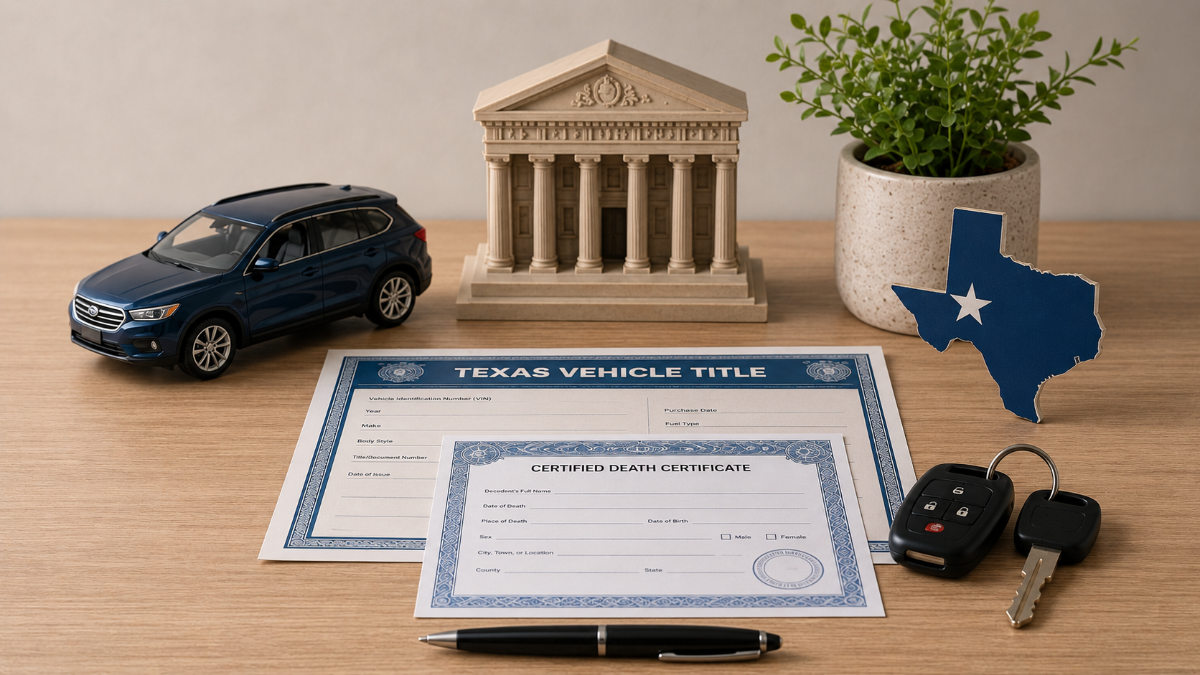
Transferring a car title after death in Texas takes five steps. The forms you need depend on the will, title ownership, and estate debts.
Step 1: Get Certified Death Certificates
Order certified copies of the death certificate from your county clerk or Texas Vital Statistics. The county tax office requires at least one certified copy for the title transfer.
Photocopies and printouts do not qualify. A certified copy carries a raised seal or stamp from the issuing office.
Most families need 4–6 copies because various institutions require an original. Order all copies at once to avoid extra fees and delays.
- Banks and financial institutions
- Life insurance companies
- The county tax office for the title transfer
Start this step before gathering any other forms. The death certificate is the one document every transfer path requires.
Step 2: Determine Your Title Transfer Type
Your transfer path depends on three factors. Did the deceased leave a will? Does the estate have unpaid debts? Does the title list a co-owner or beneficiary?
Your answers determine which path to follow.
- File for full probate when a will exists, and the estate has unpaid debts.
- Use Muniment of Title when a will exists, and the estate has no unpaid debts. This Texas-only process does not involve the executor.
- File an Affidavit of Heirship (Form VTR-262) when no will exists.
- Transfer through survivorship or Transfer on Death when the title names a co-owner or beneficiary. This path skips the court entirely.
Most families without a will transfer a vehicle using the Affidavit of Heirship. It bypasses the court and has no waiting period.
Step 3: Gather the Required Forms
Complete Form 130-U, the Application for Texas Title. You can download forms from the Texas Department of Motor Vehicles (TxDMV) website. The additional forms you need depend on your transfer type.
- Probate transfers need letters testamentary or a muniment court order from the probate court.
- Heirship transfers need a notarized Form VTR-262 signed by a disinterested witness.
- Survivorship and Transfer on Death (TOD) transfers need the original title showing survivorship language or Form VTR-121.
Bring original copies of every document. County offices reject photocopies of court orders and death certificates.
Step 4: Visit Your County Tax Office
Bring all completed forms and documents to your county tax assessor-collector office. Do not visit a TxDMV Regional Service Center. TxDMV handles bonded title applications but does not process standard title transfers.
Call your local county tax office before the visit. Some offices require extra copies or specific form versions.
Appear in person with a valid photo ID. Also, bring proof of liability insurance in your name.
Additional requirements depend on your role. An executor brings their letters testamentary. An heir using Form VTR-262 brings the notarized affidavit.
Step 5: Pay Fees and Complete Registration
Pay the title application fee and registration fees at the county tax office counter. The title application fee costs $28–$33, depending on the county. Registration fees also vary by county and vehicle type.
The county does not process transfers with an active lien. Pay off or assume the loan first.
Most estate transfers are exempt from motor vehicle sales tax under SB 2064.
Heirs have 30 days from the transfer date to register the vehicle. Late registration carries penalties. The county will issue a new title within 2–6 weeks after accepting the paperwork.
Transfer a Car Title With a Will in Texas
A will gives the probate court clear direction on who inherits the vehicle. The estate’s debts determine which path to follow: full probate or Muniment of Title.
Probate With an Executor
The probate court appoints the executor named in the will. The court issues letters testamentary to confirm the executor’s legal authority over the estate.
The executor signs Form 130-U and the vehicle title in place of the deceased owner. Bring the letters testamentary, certified death certificate, and vehicle title to the county tax office. The county tax office also accepts letters of administration as an equivalent.
The transfer cannot start until the court issues letters testamentary. The Texas State Law Library explains the full Texas probate process.
Muniment of Title
Muniment of Title is a Texas-specific legal process. The court admits the will without appointing an executor. A single transfer order replaces letters testamentary.
The estate must have no unpaid debts other than a mortgage to qualify. A Muniment of Title is faster and less expensive than full probate. Full probate legal fees start at $1,500–$2,000 in most counties, per MyBusinessLawyer.com.
Court filing fees for a muniment hearing start at $360, per the Travis County Clerk. Bring the muniment court order, certified death certificate, and Form 130-U to the county tax office.
Transfer a Car Title Without a Will in Texas
Texas intestacy law sets the inheritance order when no will exists. The surviving spouse inherits first, then children, then other relatives. Most families transfer the vehicle title using the Affidavit of Heirship for a Motor Vehicle (Form VTR-262).
Affidavit of Heirship
Form VTR-262 is a sworn statement that identifies the decedent and every heir. A disinterested third-party witness must sign the form. The witness cannot be an heir or anyone who benefits from the estate.
Only a witness who knew the deceased and their family qualifies. An heir signing as the witness is the top reason county offices reject VTR-262 filings.
All heirs sign Form VTR-262 and have the affidavit notarized. One heir signs as the seller on behalf of the estate. Another signs as the recipient.
File the notarized affidavit with Form 130-U and a certified death certificate at the county tax office.
Small Estate Affidavit
A Small Estate Affidavit works when the total estate is worth $75,000 or less (excluding the homestead). The probate court must approve it at least 30 days after the death. The heir files the affidavit in the county where the deceased lived.
Most families transferring a vehicle use the Affidavit of Heirship instead. Form VTR-262 transfers the title without probate and has no waiting period.
Joint Ownership and Survivorship Title Transfers
Joint titles with survivorship rights and Transfer on Death (TOD) designations bypass probate. The surviving owner or named beneficiary brings a death certificate and the correct form to the county tax office.
Right of Survivorship
A title marked “with right of survivorship” means the surviving owner takes full ownership when the co-owner dies. The surviving owner transfers ownership without probate or a court filing. Bring the original title, death certificate, and Form 130-U to the county tax office.
A will cannot override survivorship in Texas. Owners set up survivorship rights using Form VTR-122 when they first title the vehicle.
Transfer on Death Beneficiary
A Transfer on Death (TOD) designation names a beneficiary on the vehicle title. The named beneficiary brings Form VTR-121, a death certificate, and Form 130-U to the county tax office.
The TOD beneficiary must apply within 180 days of the owner’s death. Missing this deadline eliminates the TOD designation.
Vehicle owners can add Form VTR-121 to their estate plan. Named beneficiaries inherit the vehicle without probate.
Documents and Forms for Title Transfers
Every title transfer for inherited vehicles requires the same base documents. Some counties require extra copies or specific forms. Call your county tax office ahead of the visit to confirm.
Required for Every Transfer
Gather these six required documents before your county tax office visit.
- Certified death certificate (original copy; photocopies do not qualify).
- Form 130-U (Application for Texas Title).
- Valid photo ID of the new owner.
- Proof of liability insurance in the new owner’s name with $30,000/$60,000/$25,000 minimum coverage.
- Odometer disclosure for vehicles under 10 model years old.
- Current vehicle registration or VIN.
Additional Forms You May Need
Your transfer type determines which other forms to bring.
| Transfer Type | Additional Forms Required |
|---|---|
| Probate with an executor | Letters testamentary and court order |
| Muniment of Title | Muniment court order |
| Affidavit of Heirship | Form VTR-262 (notarized, with disinterested witness) |
| Small Estate Affidavit | Court-approved Small Estate Affidavit |
| Right of Survivorship | Original title with survivorship language |
| TOD Beneficiary | Form VTR-121 |
What to Do When the Title Is Lost
Many families arrive at the county tax office and discover that the original title is missing. The deceased may have lost it years ago. Others find that nobody ever transferred the title into the deceased owner’s name. Others find that nobody ever transferred the title into the deceased owner’s name.
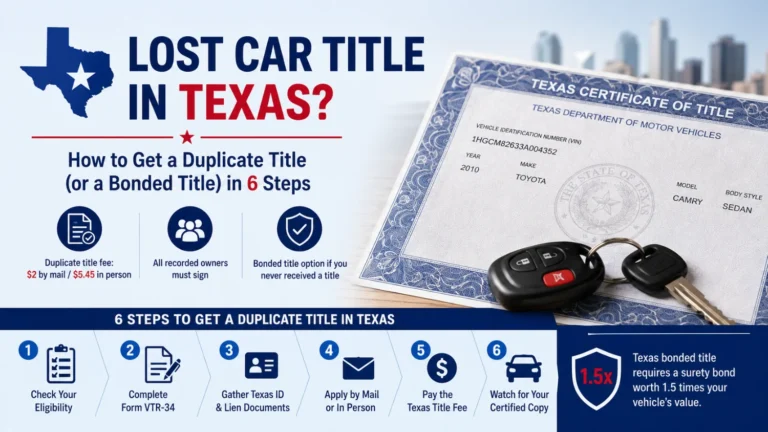
A duplicate title from the Texas DMV requires the vehicle owner’s signature. That is not possible after death. A title bond is the official TxDMV alternative.
A title bond is a surety bond that proves vehicle ownership when the paper title is unavailable. The bonded title process works in five steps.
- Submit Form VTR-130-SOF with a $15 fee to a TxDMV Regional Service Center.
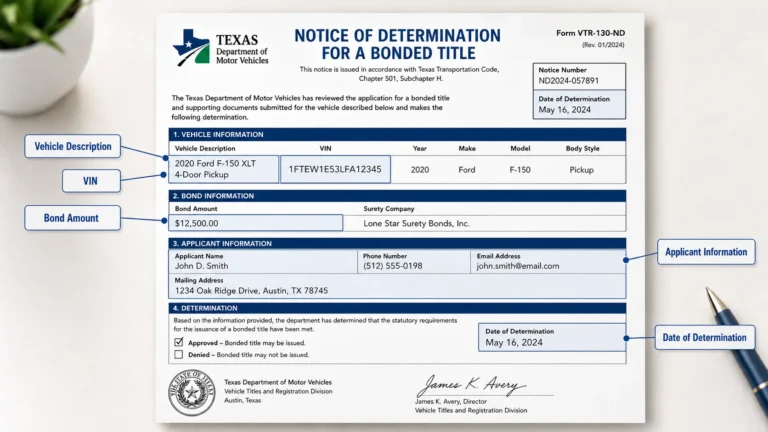
- TxDMV reviews the evidence and issues a Notice of Determination. The required bond amount is 1.5 times the vehicle’s appraised value.
- Purchase the surety bond from a licensed provider, like TMD Surety Bonds.
- File the bond, Notice of Determination, and Form 130-U at the county tax office within 30 days.
- The county issues a bonded title valid for 3 years.
TMD Surety Bonds issues title bonds for Texas vehicles through AM Best A+ rated carriers. Premiums start at $100 for most vehicles. Secure your bond today.
How to Get a Lost Car Title in Texas in 5 Easy Steps
Bonded Title vs Abandoned Title: Which One Do You Need?
Buying a Car with a Bonded Title in Texas: Is It Safe?
Title Transfer Costs and Tax Exemptions
The Travis County Tax Office charges $33 plus a $2.50 filing fee for a total of $35.50. Other counties charge $28–$33 for the title application. Registration fees also vary by county and vehicle type.
SB 2064 eliminated motor vehicle sales tax on estate and survivorship transfers on September 1, 2025. The old $10 gift tax on family vehicle transfers no longer applies. The exemption applies to the transfer date, not the date of death.
The Texas Comptroller confirms the exemption covers estate-to-distributee and survivorship transfers.
Heirs must clear any active lien before the county processes the transfer. The lender provides a lien release document once the heir pays off or assumes the loan.
Texas ended safety inspections for non-commercial vehicles in January 2025. Emissions inspections remain required in applicable counties for vehicle registration.
Get Your Title Bond from TMD Surety Bonds
TMD Surety Bonds is a family-owned agency in Fort Worth, TX. Since 2011, TMD has issued thousands of title bonds through AM Best A+ rated surety carriers.
Premiums start at $100 for most vehicles. Most customers receive their title bond the same day.
Apply for your title bond and complete your inherited vehicle transfer. Have questions? Contact TMD.
FAQs About Transferring a Car Title After Death in Texas
Find answers to common questions about transferring a car title after the death of the owner.
Is It Illegal to Drive a Deceased Person’s Car in Texas?
Driving a car registered to a deceased person is not illegal in Texas. The existing insurance policy may not cover you after the owner’s death. Texas fines for driving without insurance reach $1,000. Contact the insurer to update coverage before driving.
Do You Have to Pay Taxes on an Inherited Vehicle in Texas?
Most inherited vehicle transfers in Texas are now tax-free. SB 2064 eliminated motor vehicle sales tax and the $10 gift tax on estate transfers. The exemption took effect September 1, 2025, and covers both estate-to-distributee and survivorship transfers.
What Happens to a Car Loan When the Owner Dies?
A car loan survives the owner’s death. The lien remains on the title. The county tax office will not process a transfer until the heir pays off or assumes the loan. Heirs who do not want the vehicle can let the estate sell it to pay off the loan.
How Long Does a Title Transfer Take After Death?
The title transfer process after death in Texas takes 2–6 weeks in most counties. Survivorship and TOD transfers finish fastest. Probate transfers take longer because the court must first issue letters testamentary or a court order.
Can I Sell a Deceased Person’s Car Before Probate?
You cannot sell a deceased person’s car in Texas until the title is in your name. Complete probate or file an Affidavit of Heirship first. Selling a vehicle without a proper title transfer violates Texas motor vehicle law.